From TH9 to TH15: Blueprint’s Hilariously Effective Base Building Secrets
In 2026, Clash of Clans has evolved into a battlefield where a poorly placed cannon can unravel a month’s worth of trophy pushing in seconds. Fortunately, the Blueprint crew has been quietly assembling a masterclass in defensive architecture, one livestream at a time. Their tutorials aren’t just guides—they’re theatrical performances where a handful of supercharged builders turn digital grass and stone into labyrinths that make attacking clans weep into their spell factories. Watching a Blueprint base come together is like observing a chef who seasons a dish not with salt, but with invisible tripwires and vengeful lava hounds.
At the heart of this operation is a global coterie of experts, each a virtuoso of a specific Town Hall level. They craft bases the way a watchmaker assembles a tourbillon: every spring, every trap, every seemingly innocent empty space serves a devastating purpose. The team doesn’t just place buildings; they weave a dreamcatcher of death, where each defensive knot is calibrated to snatch an attacker’s troops out of their planned path and dump them into a nightmare of splash damage. The result? An anti-three-star stronghold that feels less like a village and more like a Rube Goldberg machine powered by your opponent’s hubris.
Consider the TH9 war base by Gastong G, a foundational gem from the series. It proudly carries a Clan Castle Hound, which acts like a honey badger with wings—pops up, distracts, and refuses to die while archer towers pick off the confused raiders. Fast-forward to TH10, where Gastong returns with a dual-offering: one base stocks two Super Minions, a Head Hunter, and a smattering of Archers, a composition akin to a murderous jazz trio that solos the enemy Queen. The second variant swaps in a Dragon, Witch, and Archers, turning the core into a cauldron of chaos where tanks get melted and swarms get wiped. Moving up, John’s TH11 build introduces Rocket Loon synergy that redefines “air superiority,” while Marc’s TH12 masterpiece and Ruposh’s TH13 fortress deploy Super Minion and Head Hunter combos with surgical precision—imagine a chess match where your opponent’s knights are incinerated before they can gallop. Even Alfonso’s TH14 design, armed with a Lava Hound and Goblin cleanup crew, proves that even at the apex, a little bit of green mischief can turn a sweep into a squeak.
TH15, once a whispered pre-order, is now a fully integrated chapter in this living encyclopedia. The builders have adapted to the Monolith’s petrifying glare and the Spell Towers’ tricks as if they’d been playing with them since kindergarten. Every new base emerges from a real-time building session where the architect starts from a blank canvas and painstakingly drags each wall segment, bomb, and X-Bow into place while a live audience suggests murder holes and trap placements. This process is less about following a template and more like a jazz improvisation—a collective call-and-response that forms a symphony of symmetrical doom.
The Blueprint philosophy doesn’t stop at design. They’ve built a whole ecosystem around improvement, with a YouTube playlist that stacks hundreds of tutorials like pancakes. A player stuck at TH11 can binge-watch siege-proof layouts; a TH9 novice can study how to deflect hogs with the grace of a matador. The sheer depth of content makes the old excuse “my base sucks because I don’t know how” sound as flimsy as a Level 1 wall. In the Blueprint universe, ignorance is a choice, and that choice comes with a three-star penalty.
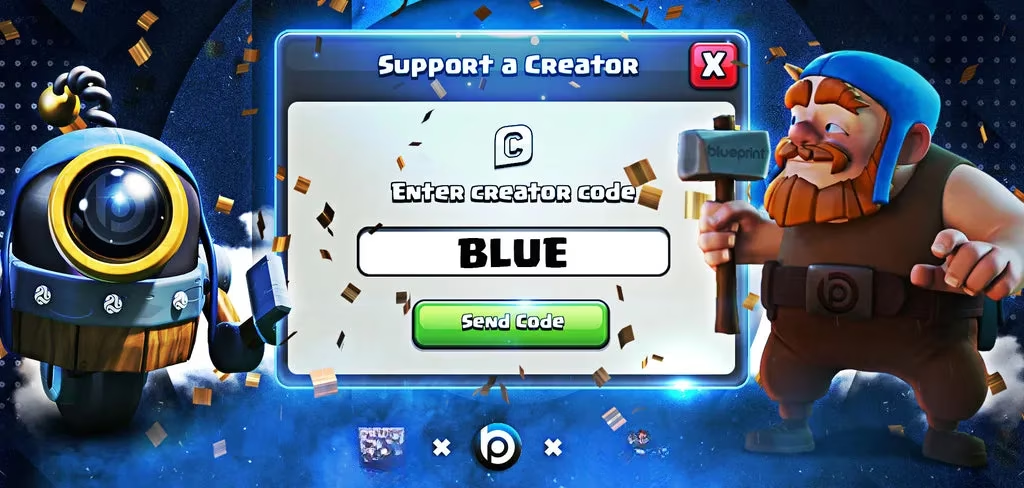
To keep this circus of genius running, they ask for small tributes: a thumbs up, a subscription, and the ritualistic ringing of the notification bell. The real magic, however, lies in Creator Code BLUE. Using it before grabbing a Gold Pass or a special offer is like slipping a secret thank-you note to the people who make sure your Town Hall doesn’t become a lawn ornament for passing Valkyries. And for those who prefer to read the fine print before a single troop is deployed, their website and Discord serve up fresh schematics with the urgency of a deployment log.
Ultimately, a Blueprint base is a work of psychological warfare. Opponents don’t just scout it; they stare into its asymmetrical corridors and feel their carefully honed attack strategy decompose into a puddle of doubt. It’s the architectural equivalent of a three-dimensional chessboard where every pawn is actually a spring-loaded pitfall. So, if your current war base still looks like a birthday cake left out in the rain, maybe it’s time to let the masters redraw your blueprints. After all, in Clash of Clans, the only thing better than a flawless attack is a defense so devious it becomes a spectator sport.